Showing posts with label privacy. Show all posts
Monday, October 11, 2010
Cloud Computing: Is there a threat?
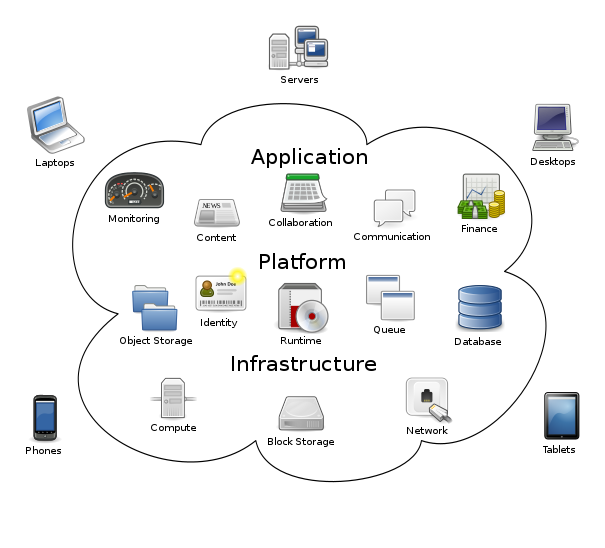
During the LinuxFestJo event last Saturday, I had a chat with Noha Salem, an Egyptian Googler, about Google's upcoming agenda and future plans for the IT industry. Everything she said was pretty interesting, until she reached the issue of cloud computing. She argued that cloud computing is certainly the trend of the future, which is somewhat true. However, what raised my suspicions was when she claimed that the cloud is going to totally, but slowly, replace the desktop, to the extent that desktop applications will slowly become obsolete and unsupported over time. This this is where I'd like to declare my stance against Google, and/or any other company, firm or organization which adopts such views for the future of computing.
Perhaps the most sensitive aspect in the issue of cloud computing is the issue of privacy and personal security. Personally, I have no idea how storing all my personal data and personal files (images, documents, audio and video stuff) on some server located somewhere on another continent can be even remotely as private, safe and secure as storing them on my personal machine and then sharing them with the world as I wish. The irony is that when I tried to tell Noha that there will be many people who will refuse to place all the personal stuff on the cloud, her only response was something like: "Oh, of course there will be a great consideration for personal preference!". But then, how is there going to be any kind "relevant" personal preference when the ability to store files and data on a completely isolated machine will not be available anymore? In my opinion (please correct me if I'm wrong), cloud-hosting service providers can brag all they want about the levels of privacy and security they provide, but the fact remains that the cloud will never be even half as trustworthy, when it comes privacy and security, as the desktop.
Another critical issue about cloud computing has to do with the fact that internet speeds vary from one country/region to another. Here in Jordan, for example, internet speeds could barely exceed 10mbps (which, by the way, is not even remotely affordable by middle class citizens). However, in other regions in the Arab world on the other hand, such as the UAE, internet speeds reach as high as 30mbps, especially with the new eLife service provided by Etisalat. Moreover, what about those who can't afford an internet connection altogether? You're not trying to convince me that we'll have completely defeated the entire world's poverty by the time the cloud computing trend takes the lead, are you?
Conclusion, it's not that I'm totally against cloud computing. Of course not. I actually think it's a great technology; but I am, however, against the idea of total migration to it, to the extent of totally flushing the desktop down the toilet. I believe that balance is always the best thing to do.
Saturday, April 17, 2010
Free Software is not about deception, Free Software is about caring for others
A couple moments ago, I was just tinkering around with Pidgin, the famous free open source IM client. And for the first time ever, I finally stumbled upon an excellent feature that's been staring back at me for quite some time now, but for some reason, I've never cared to know what it is until now. The feature is called "OTR" which stands for "Off The Record messaging".
And from this link we find that OTR is a feature that provides a way of assuring the privacy of the messages exchanged between a group of people chatting over the internet without taking the risk that some certain private and sensitive parts of their conversation might be exposed to other impostors or parasitic human entities. And it works by using a specific encryption scheme that guarantees the safety of the messages from the reach of outsiders.
And now this makes me wonder, what if Pidgin was proprietary software? Would its makers still give a damn about whether the users are guaranteed their full privacy and security while using it? Or will it be just another piece of software that's full of deceptive eye-candy from the outside, while the inside (i.e. the under-the-hood stuff) can be as far from security and privacy as east is from the west? The difference between proprietary and free open source software is in the fact that in FOSS, the source code is open and visible to everyone, meaning that if there's anything wrong with the source code, it can be easily detected and fixed. On the other hand, proprietary software keeps the source code visible only to its owners, which means that the owners/developers of a proprietary software can write all the code they want (be it good for the user or not) and nobody will ever know for sure what they wrote because their code is only visible to them, which simply means that they can be spying at every single action done on their software while the user is unaware of anything because A) He can't see the source code. And B) Because he's busy enjoying the deceptive eye-candy of the software (e.g. Nice interface, exciting features, etc.). And a widely known example of that kind of disrespect for the user's privacy is the DRM feature hidden in a wide range of famous proprietary technologies such as Apple's iPod or Amazon's Kindle.
Now, if we ponder this issue a little bit, and ask ourselves this question: Why do we find most FOSS projects much more respectful to the user's rights of privacy and security than their proprietary counterparts? We can even find a number of FOSS projects that not only respect the user's privacy, but are actually dedicated to providing the user with a safe, secure, private and anonymous networking environment. Such projects include the Tor project, and the famous web site Wikileaks.org. In fact, during a conference about web anonymity in Jordan last year, Jacob Appelbaum from the Tor project clearly stated: “If protecting people's rights of privacy and anonymity would get me jailed, then I'm fine with it.” *
But now on the other hand, another question comes in:
Are Microsoft's Most Valuable [Hypocrites] ready to sacrifice everything if it was the only way to protect the Windows users' rights of privacy and anonymity as well? Are they willing to say the truth, the whole truth and nothing but the truth about the nefarious doings of the company they're advocating, regardless of the consequences?
For example, what is it that makes this gentle man at PCWorld lie deliberately and blatantly, claiming that “Microsoft takes the security issue more seriously than Apple does”?
From the way I see it, Microsoft's advocates are just too drunk to think honestly about their actions, for all these people have in mind is money, as it is the main and only thing that drives them.
Subscribe to:
Posts (Atom)